|
Project Main Goals |
|
The proposed synchronous interconnection of Moldova and Romania electricity grids represents an important step forward towards greater regional integration of the European single electricity market.
This process will allow participation of the Republic of Moldova in the European electricity market - through connections with the European grid (“ENTSO-E”).
Main goals for this project current planning stage are:
-
Feasibility Study covering technical and economic analysis, including multicriteria assessment (MCA) for choosing the optimum transmission line route Strășeni, Moldova – Gutinaș, Romania 400kV Transmission Line, including a new 400 kV electrical substation near the existing 330/110 kV ES Strășeni (MD) and upgrading works at the existing 400/220/110 kV ES Gutinaș (RO);
-
Environmental and Social Impact Assessment (ESIA) final documentation package, to be submitted for obtaining the Environmental Approval under the legislation of the Republic of Moldova.
|
|
Beneficiary |
-
Î.S. MOLDELECTRICA – High Voltage Electricity Networks Branch located in the Central part of the country – the TSO in Republic of Moldova.
|
|
Consultants Consortium |
|
Project current planning stage:
-
Black & Veatch, USA
-
Energy and Environment Consulting Company (CCEM), RO
|
|
Project duration |
Planning stage: 16-18 months
-
Feasibility, environmental and social impact assessment (subject of this leaflet)
Implementation stage: 3-4 years
-
18 months – Procurement, Basic-Detail Engineering, Permits, Land Acquisitions (expropriations)
-
20-21 months – Construction, including work-site organisation, tests and commissioning
O&M stage: 30-40 years;
Closure: 3-8 months |
|
Expected results during current planning stage |
-
Feasibility Study
-
ESIA Scoping (Phase I) and ESIA final documentation package (Phase II).
The feasibility study and ESIA Scoping have been developed and approved. The ESIA final package is currently ongoing. Upon obtaining the environmental approval in accordance with the requirements of the Republic of Moldova Law No. 86/2014 on Environmental Impact Assessment, the project will enter the implementation stage, including the preparation of the FEED - Front-End Engineering Design, construction and other permits, on-site preparation, construction and installation of equipment, and commissioning.
|
|
Financing |
|
Funding for the Feasibility and ESIA Scoping studies for Strășeni (MD) – Gutinaș (RO) 400kV T-Line, as well as for the final full ESIA covering the section located within the Republic of Moldova, is provided by the U.S. Government under the Investments in the Development of Energy Assets (IDEA) project managed by the U.S. Department of State (DOS).
|
|
|
|
Key aspects analysed |
|
At this planning stage, the following components of the project are analysed in terms of technical, economic, environmental and social issues:
✓ Strășeni, MD – Gutinaș, RO 400kV Transmission Line;
✓ Both Electrical Substations (ES): Strășeni, MD and Gutinaș, RO.
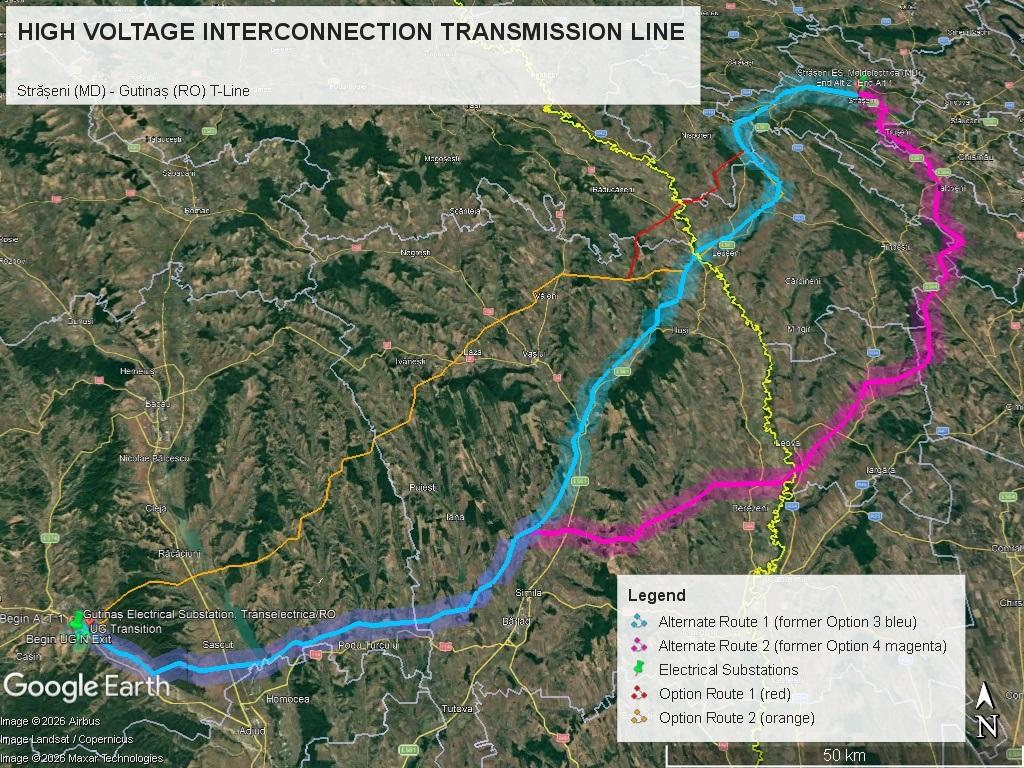
For choosing the optimum route for the 400 kV T-Line, 4 options were initially analysed (Figure 1) based on the MCA including over 45 comparative criteria, of which the most relevant were:
-
Technical (e.g., length; co-existence with other investment projects, such as roads, railways, other overhead power lines, telecommunication lines, various pipelines, etc.; accessibility of the route / levels of difficulty; investment costs, etc.);
-
Socio–economic (e.g., access to agricultural land; deforestation; type of land ownership when crossing local communities, in areas of productive agricultural land; relocation or compensation; temporary impact on air quality (dust and suspended particles), noise due to increased road traffic intensity and volume during site preparation and construction, etc.);
-
Environment (e.g., crossing protected forested areas, rivers, and lakes; impact of the electromagnetic field; impact on ecosystems, flora, and fauna; visual impact, etc.);
-
Cultural heritage (e.g., impact on heritage buildings and monuments; crossing archaeological sites, etc.).
After a preliminary MCA and September 2024 onsite scoping mission, along the T-Line routes in both countries, two alternative routes [1 (blue) and 2 (magenta)] were highlighted, in order to narrow down the Feasibility and ESIA scoping analyses. In the end, in order to prevent, avoid and minimise the potential impact generated by the project, the blue route (Alternate 1) was selected as optimal.
|
|
Stakeholders |
-
Government and Policy Makers
-
Regulatory Authorities
-
Local and Regional Authorities
-
Projects Developers and Investors, Financing Bodies
-
R&D Institutes and the Academic Environment
-
NGOs
-
Local community, potentially affected public, neighbouring settlements, vulnerable groups
-
Mass-media
|
|
For additional information: |
|
Please consult the documents made available at the bottom of the page.
Throughout the current project planning stage, participants in the consultation process will receive a questionnaire / grievance form from the organizers. Completed forms may be submitted to the general secretariat of the relevant local city hall for review and follow-up.
Any comments or concerns can be communicated to the beneficiary - Moldelectrica, Republic of Moldova either verbally (by phone) or in writing (by post or email) by completing the mentioned form.
Printed versions of the ESIA and SEP reports, Project Factsheet and Grievance Form, will be made available, upon request, at MOLDELECTRICA headquarters from:
-
Central Office (MD-2012, mun. Chișinău, 78 V. Alecsandri str.; ph: 00373 (22) 25-35-59)
-
RETI Centru High Voltage Electricity Networks Branch (MD-2055; or. Vatra, 13 Luceafărul str.; ph: 00373 (22) 30- 93-59)
-
330 kV Strășeni Electrical Substation (MD-3700, or. Străşeni, 14 M. Costin str.)
|
|
Project Managers: |
|
Beneficiary
Consultants
-
Dr. Olga MANDRUGINA, Project Manager, IDEA - Black and Veatch - USA (mandruginaoa@bv.com)
-
Dr. Claudia TOMESCU, Project Manager and Head of Projects Development Dpt., CCEM - Romania (claudia.tomescu@ccem.ro) CCEM – România
|
|